Planning & Ecology Support
Biodiversity Net Gain (BNG)
Helping you meet the mandatory 10% biodiversity gain requirement with clear assessments, robust landscape design and ecologist-led reporting.
What is Biodiversity Net Gain?
A new legal requirement for most UK developments
Biodiversity Net Gain (BNG) is now a mandatory part of the UK planning system. Most developments must demonstrate at least a 10% increase in biodiversity value compared with the pre-development baseline. This improvement must be secured for the long term, ensuring habitats are created, protected and enhanced well beyond completion.
For many clients, the ecological requirements can seem overwhelming. We simplify the process – working closely with ecologists to assess your site, develop realistic habitat strategies and provide the documentation required for planning approval.
Tags
BNG Assessment DEFRA Metric Habitat Creation Planning Support Ecological Improvement
Service snapshot
- Client types
- Developers, architects, planners, private homeowners
- Scope
- BNG assessments, DEFRA metric calculations, habitat creation plans, reporting, offsite unit advice
- Key deliverables
- DEFRA Metric, baseline assessment, habitat proposals, management strategy and planning-ready BNG report.
Why it matters
Ensuring your development meets legal biodiversity standards
BNG is more than a planning hurdle – it is now a statutory requirement. Planning authorities expect clear ecological evidence, realistic habitat proposals and long-term stewardship arrangements before permission is granted.
Our role is to help you navigate this process efficiently. By working alongside qualified ecologists, we identify existing habitats, calculate biodiversity values and translate ecological requirements into practical landscape design solutions that work with your scheme.
BNG process at a glance
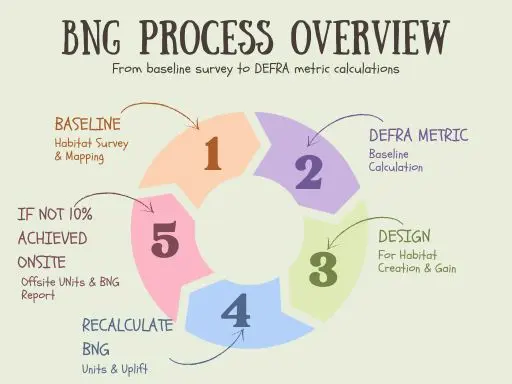
The diagram shows how we move from baseline survey to DEFRA metric calculations, integrated landscape design, BNG reporting and, if needed, offsite units. Each step is designed to keep your project compliant and moving smoothly through planning.
Our approach
How we deliver your BNG assessment and strategy
We combine ecological input, robust metrics and practical landscape design to create a clear, defensible pathway to achieving your biodiversity targets.
1 · Baseline assessment
We begin with a detailed audit of your site’s existing habitats. Using the DEFRA Metric, we quantify current biodiversity value and determine what the development will displace.
2 · Designing for biodiversity gain
Wherever possible, we integrate habitat enhancement and creation directly into the landscape design – woodland edges, meadow planting, hedgerows, ponds and ecological corridors.
3 · Reporting & long-term strategy
We produce the BNG Assessment Report, including habitat management plans, mapping, cost estimates and monitoring recommendations ready for planning submission.
WHEN 10% IS NOT ACHIEVABLE ONSITE
Supporting projects that cannot reach 10% onsite
Some sites, particularly private dwellings and constrained plots, simply cannot achieve the mandatory 10% uplift onsite. In these cases, BNG still must be calculated, but the uplift is achieved offsite through the purchase of BNG Units.
Private & small sites
Private gardens and compact plots often lack the space and long-term management mechanisms required to safeguard habitats for 30+ years.
Calculating the deficit
We calculate the biodiversity shortfall, identify habitat types in deficit and determine how many offsite units are needed to reach 10% gain.
Offsite units guidance
We advise on offsite BNG Units – habitat types, indicative costs and routes to purchase through approved habitat banks or local schemes.
FAQ
Frequently asked questions about BNG
What is Biodiversity Net Gain (BNG)?
BNG is a legal planning requirement ensuring that most developments deliver at least 10% more biodiversity value after construction than before.
Do all developments need to provide BNG?
Most developments do. Some exemptions exist, but almost all planning applications now require a DEFRA Metric assessment and evidence of biodiversity gain.
How is BNG measured?
BNG is measured using the DEFRA Biodiversity Metric, which scores habitats based on type, area, condition and strategic significance. Post-development units must be at least 10% higher than baseline.
Why can’t private dwellings achieve 10% BNG onsite?
Private gardens cannot usually be secured and managed for the required 30+ years, so even if habitat is created, it cannot be counted towards the legal BNG uplift.
What happens if my site cannot reach 10% onsite?
You will need to purchase offsite BNG Units. We calculate the deficit, identify required habitat types and provide guidance on sourcing appropriate units and indicative costs.
What does your BNG report include?
The BNG report includes the DEFRA Metric spreadsheet, baseline habitat maps and scoring, proposed habitat creation and enhancement, management recommendations and, where relevant, offsite unit calculations.
When should BNG be assessed?
As early as possible. BNG now forms part of planning validation, so missing or incomplete information can delay your application.
Need help with Biodiversity Net Gain?
Whether you are a developer, architect or homeowner, we can guide you through every step of the BNG process – from baseline assessment and DEFRA Metric through to habitat design, reporting and offsite units.
Contact us